
You have 0 items in your cart

Navigating Tax-Deferred Real Estate Exchanges
A 1031 exchange lawyer is a specialized attorney who helps real estate investors defer capital gains taxes by properly structuring property exchanges under Section 1031 of the Internal Revenue Code. When considering a 1031 exchange, look for qualified legal counsel with:
- Expertise: Choose an attorney with experience in IRC Section 1031 transactions
- Transaction Volume: Look for lawyers who have handled hundreds of exchanges
- Multidisciplinary Knowledge: Select counsel with both tax and real estate expertise
- Timing Awareness: Ensure they understand the critical 45-day identification and 180-day closing deadlines
When selling investment property, paying up to 20% in federal capital gains taxes can significantly reduce your reinvestment power. A properly executed 1031 exchange allows you to defer those taxes, preserving your equity for wealth building.
As attorney Ray M. Beck notes: “The security of exchange funds must be of the highest priority.” This highlights why specialized legal guidance is crucial – a single misstep can trigger immediate tax liability.
I’m Michael Hurckes, Managing Partner at Ironclad Law with extensive experience guiding clients through complex 1031 exchange transactions that maximize tax deferral while ensuring compliance with IRS regulations.
1031 Exchange 101: How the Like-Kind Swap Works
Think of a 1031 exchange as a financial tool that savvy real estate investors use to build wealth. Named after Section 1031 of the Internal Revenue Code, this strategy lets you sell one investment property and buy another without immediate taxation on your profits.
Here’s why it matters: when you sell an investment property at a profit, the IRS typically wants their share right away. With a properly structured 1031 exchange, you can defer those taxes as long as you reinvest the proceeds into qualifying “like-kind” property.
Let’s look at the financial impact:
– If you sell a property for $200,000 with a $40,000 gain
– Without a 1031 exchange, you might pay $8,000 in capital gains tax (at 20%)
– That leaves only $192,000 to reinvest
– With a 1031 exchange, you keep the full $200,000 working for you
I recently watched a client leverage this advantage to purchase an $800,000 replacement property instead of being limited to a $520,000 property with the same down payment percentage.
According to IRS safe-harbor rules, specific timelines and procedures must be followed to qualify for tax deferral. This is where having a 1031 exchange lawyer becomes invaluable.
What Types of Property Qualify?
Since the Tax Cuts and Jobs Act of 2018, 1031 exchanges are limited to real estate. The definition of “like-kind” for real estate is quite broad.
Qualifying real property includes rental properties (residential and commercial), office buildings, retail spaces, industrial facilities, vacant land, agricultural properties, certain oil and gas interests, and timber rights. You can exchange an apartment building for raw land, or a strip mall for a warehouse.
The IRS doesn’t restrict geography (as long as both properties are in the United States). You can swap a Minnesota duplex for a Florida beach rental, provided both properties are held for investment or business purposes.
Can Personal Residences Ever Qualify?
Your primary residence typically doesn’t qualify for a 1031 exchange, but there are exceptions that a good 1031 exchange lawyer can help steer.
If you convert your primary residence to a rental property and hold it as an investment for a sufficient period (typically at least one year), it may become eligible for exchange treatment.
Properties with partial business use present another opportunity. If you have a dedicated home office that you legitimately use for business, that portion might qualify for partial exchange treatment.
One effective strategy combines the primary residence exclusion (Section 121) with a 1031 exchange. This works well for properties like duplexes where you live in one unit and rent the other.
IRS Rules, Deadlines & Structures You Must Nail
The IRS doesn’t mess around with 1031 exchanges. One missed deadline can derail your entire exchange and trigger an immediate tax bill that could cost you thousands.

Two critical deadlines govern 1031 exchanges:
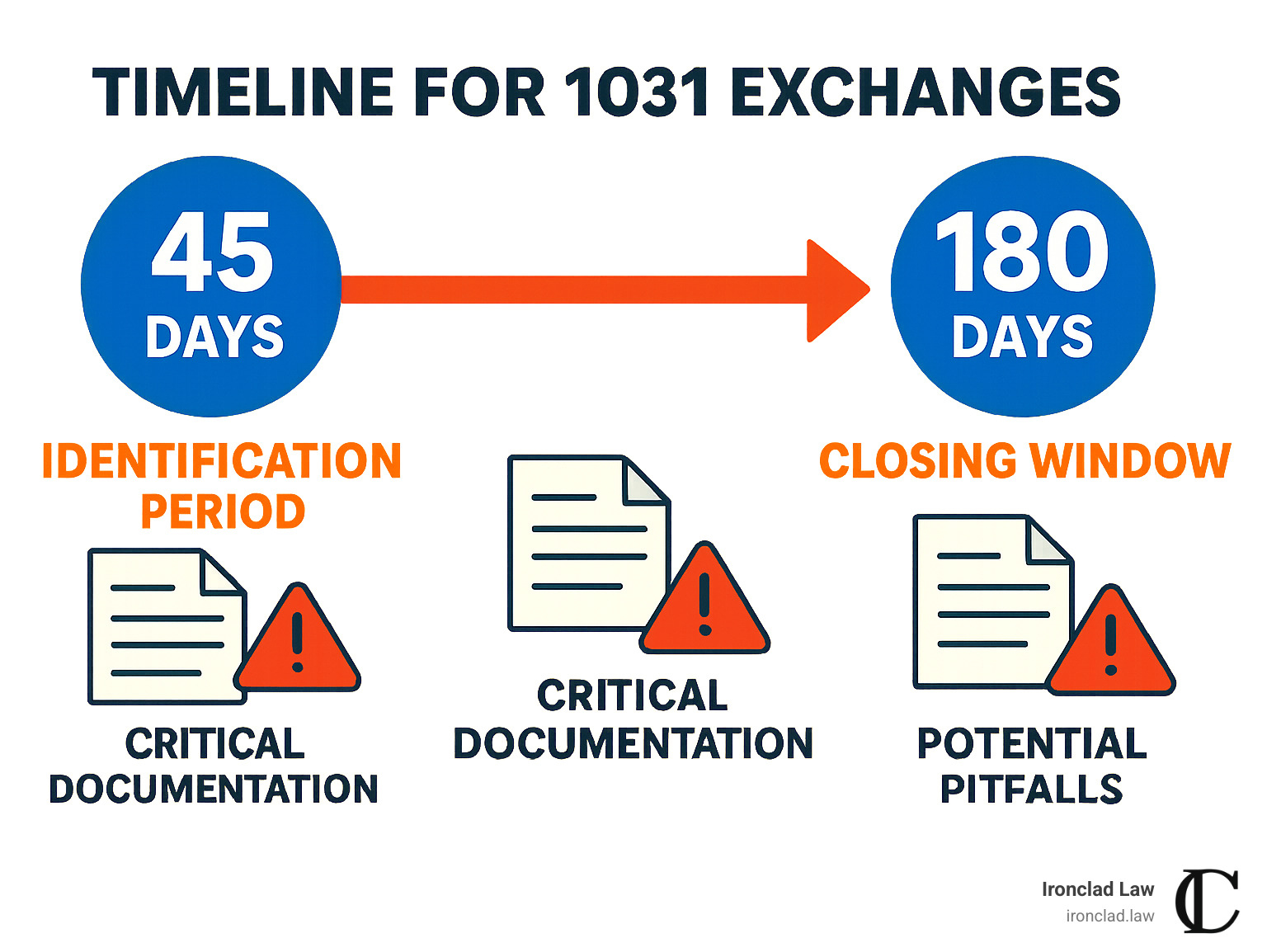
First, the 45-day identification period starts when you close on your relinquished property. Within these 45 calendar days, you must identify potential replacement properties in writing. The IRS offers three identification methods: identify up to three properties of any value; identify any number of properties as long as their combined value doesn’t exceed 200% of your sold property’s value; or identify any number of properties if you acquire at least 95% of the total value identified.
Second, the 180-day exchange period gives you 180 calendar days from your sale to complete the acquisition of your replacement property. If your tax return is due before the 180 days expire, you’ll need to file an extension or close by your tax deadline.
Other key rules include the same taxpayer rule requiring identical ownership between properties, and the equal-or-greater value requirement to defer 100% of your capital gains tax. The no constructive receipt rule means you can never touch the money during the exchange, making a Qualified Intermediary mandatory.
| Exchange Type | Structure | Timeline | Best For | Complexity |
|---|---|---|---|---|
| Forward Exchange | Sell first, then buy | Standard 45/180 days | Most investors | Low |
| Reverse Exchange | Buy first, then sell | 180 days to sell after purchase | Hot markets | High |
| Improvement Exchange | Build or improve replacement property | 180 days to complete improvements | Custom needs | Very High |
Reverse & Improvement Exchanges At a Glance
With a reverse exchange, you buy first and sell later – invaluable in hot markets where waiting might mean missing out on the perfect replacement property. The IRS provides a safe harbor under Revenue Procedure 2000-37 for these exchanges, typically involving an Exchange Accommodation Titleholder (EAT).
Improvement exchanges let you use exchange funds to make improvements on your replacement property. All improvements must be completed within the 180-day exchange period, and the property must be held by the EAT until transferred to you.
Related-Party & Partnership Traps
Exchanges involving family members or business partners create special challenges. With related parties, both sides generally must hold their respective properties for at least two years after the exchange.
Partnership interests create complexity because partnerships themselves are the taxpaying entity. The “drop and swap” approach converts partnership interests to tenancy-in-common ownership before the sale. The “swap and drop” completes the exchange at the partnership level before distributing property to partners.
These partnership solutions often require planning a year or more before your intended sale. The IRS occasionally provides relief through disaster extensions, like those issued after major hurricanes or during the COVID-19 pandemic.
Why You Need a 1031 Exchange Lawyer
While a 1031 exchange might seem straightforward, it involves navigating complex tax regulations, contractual requirements, and strict deadlines where a single misstep can cost you your entire tax deferral.

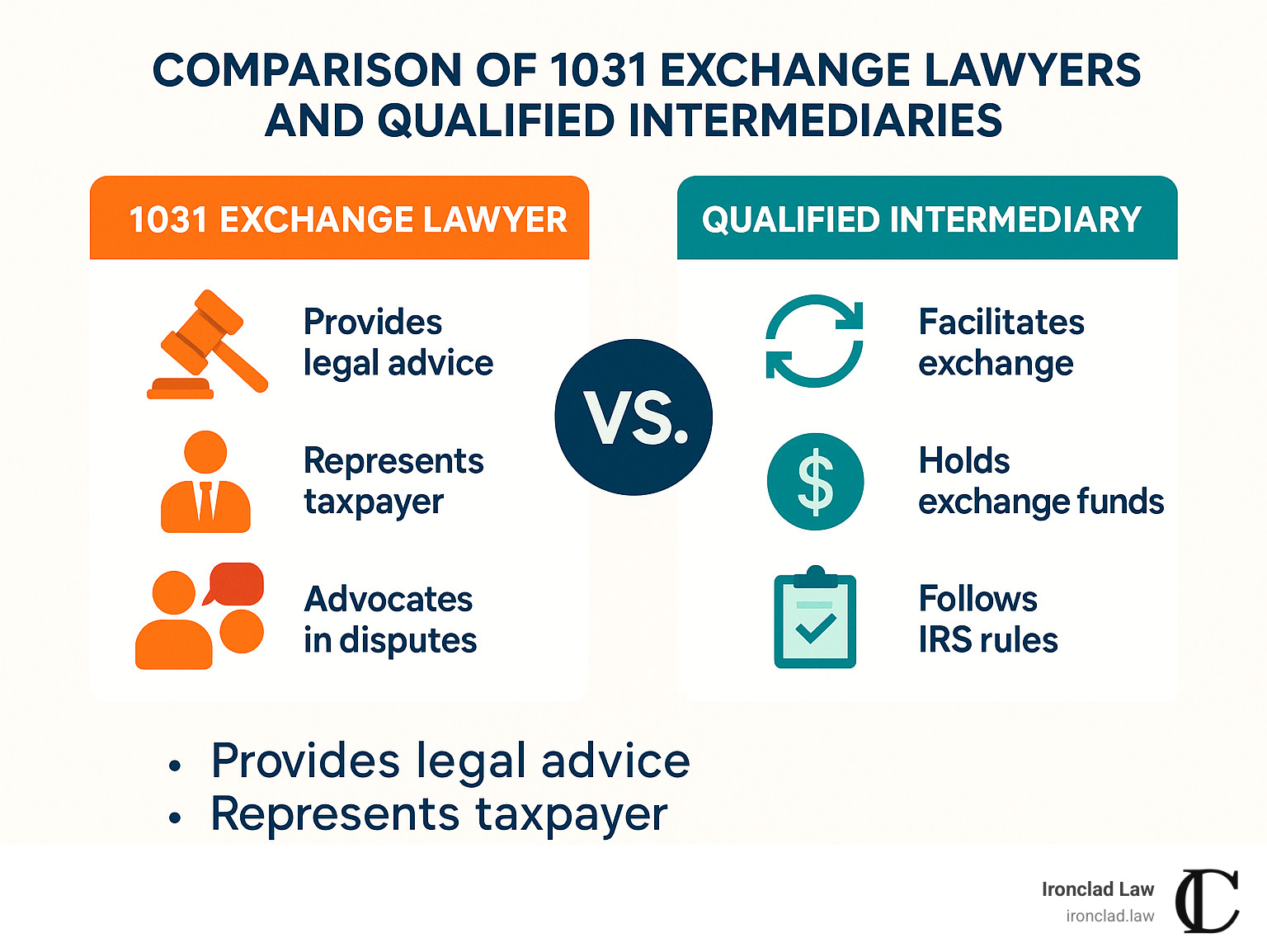
Unlike general real estate attorneys, a dedicated 1031 exchange lawyer brings specialized knowledge of both tax law and real estate transactions. At Ironclad Law, we protect your financial future through every step of the exchange process.
The fiduciary duty we hold as attorneys means we’re legally obligated to put your interests first. This stands in contrast to many intermediaries who simply facilitate transactions. When a Florida client came to us after a DIY exchange attempt resulted in an $87,000 tax bill, we realized how often investors underestimate the value of specialized guidance.
We craft purchase agreements with specific 1031 exchange language that protects your position. One client recently thanked us for spotting problematic language in a seller’s contract that would have jeopardized their entire exchange.
Title issues can derail even carefully planned exchanges. Our team identifies and resolves potential problems before they threaten your transaction. Should questions arise about your exchange, we handle all communication with the IRS to defend the transaction’s validity.
Perhaps most importantly, we help ensure your exchange proceeds are properly secured throughout the transaction.
Core Duties of a 1031 Exchange Lawyer
A skilled 1031 exchange lawyer begins by analyzing your situation to determine the optimal exchange structure and identify potential complications before they arise.
We create a comprehensive due-diligence checklist covering all legal, tax, and timing requirements specific to your exchange. This attention to detail prevents costly oversights.
We draft or review all necessary documents, including exchange agreements, assignment contracts, identification notices, qualified intermediary agreements, and closing documents. Each document must contain precise language to satisfy IRS requirements.
When conflicts arise, we advocate for your interests and work to preserve your exchange eligibility. One New York client faced a seller who attempted to back out mid-exchange – our intervention saved the deal and preserved their tax deferral.
We also coordinate between all parties, synchronizing efforts between real estate agents, qualified intermediaries, title companies, lenders, and accountants to ensure seamless execution.
Can a 1031 Exchange Lawyer Also Be the Qualified Intermediary?
Generally, an attorney who has provided services to you within the past two years cannot serve as your qualified intermediary unless those services were limited solely to facilitating 1031 exchanges.
The IRS created the “two-year disqualification rule” to ensure intermediary independence. This rule disqualifies certain “agents” from serving as qualified intermediaries, including your attorney (with limited exceptions), accountant, real estate agent, and employees.
Several alternatives exist. An attorney who hasn’t represented you in the past two years could potentially serve as your intermediary. Some law firms have separate entities for handling exchanges. Many firms, including Ironclad Law, maintain relationships with independent qualified intermediaries they trust.
How a 1031 Exchange Lawyer Protects You From Costly Pitfalls
1031 exchanges can feel like navigating a minefield. One wrong step, and your tax savings vanish. This is where having a dedicated 1031 exchange lawyer makes all the difference.

Even savvy investors stumble over common pitfalls. Take the 45-day identification period – it waits for no one. At Ironclad Law, we create bulletproof identification documents that satisfy IRS standards and ensure timely delivery.
The 180-day closing window presents another challenge. Miss it by a day, and your tax deferral evaporates. We build buffer zones into your timeline and anticipate potential roadblocks. When a Florida client’s closing was delayed by an unexpected title issue, our contingency approach saved their exchange and over $240,000 in taxes.
Seller financing brings complications. When you provide financing to your buyer, you might inadvertently create taxable “boot” unless properly structured. We can implement solutions like having the note paid directly to your qualified intermediary.
Refinancing timing matters. Do it too close to your exchange, and the IRS might view it as a “step transaction” designed to access cash while avoiding taxes. We help time refinancing to minimize scrutiny.
Perhaps most dangerous is constructive receipt. If you access your exchange funds – even briefly – your entire exchange could be disqualified. A New York client nearly lost millions in tax deferral when a title company mistakenly issued a proceeds check directly to them. Because we had included specific exchange language in the closing instructions, we caught the error before the check was cashed.
1031 Exchange Lawyer Tactics for Complex Scenarios
For partnerships where some partners want to cash out while others want to exchange, we’ve developed effective strategies like creating tracking allocations or converting to a tenancy-in-common arrangement before the sale.
Estate planning and 1031 exchanges can work together with the right approach. We help clients structure ownership entities that facilitate eventual stepped-up basis benefits. For passive investors, Delaware Statutory Trusts (DSTs) can serve as qualified replacement properties.
When seller financing is part of your plan, we can structure the note to be held by the qualified intermediary or create installment sale reporting to spread any taxable boot.
Multi-asset exchanges require careful handling of both real property (eligible) and personal property (ineligible) components through proper documentation.
Disaster Relief & Recent IRS Updates
The IRS periodically provides extensions for taxpayers affected by federally declared disasters. During Hurricane Ian, we helped Florida clients use these provisions to successfully complete exchanges that would otherwise have failed due to property damage and closing delays.
These relief provisions typically extend both the 45-day and 180-day deadlines, but only if you meet specific criteria. At Ironclad Law, we monitor IRS notices and disaster declarations to ensure our clients receive available timeline extensions.
If you’re planning a complex exchange, our Real Estate Transaction Checklist can help you avoid costly mistakes.
Choosing the Right 1031 Counsel & Qualified Intermediary
Selecting the right 1031 exchange lawyer and qualified intermediary is perhaps the most important decision in your exchange process. The wrong choice can lead to missed deadlines, improper documentation, or even loss of exchange funds.
Think of choosing your exchange team like selecting a guide for climbing a mountain – you want someone who’s made the journey countless times. At Ironclad Law, we believe this decision deserves careful consideration.
When evaluating legal counsel, consider experience volume first. There’s no substitute for an attorney who has handled hundreds of exchanges. Our team at Ironclad has successfully structured over 1,000 exchanges across everything from simple residential rentals to complex commercial portfolios.
Specialized knowledge matters tremendously. During your initial consultation, ask detailed questions about scenarios similar to yours. A true 1031 exchange lawyer should immediately recognize the nuances of your situation and offer specific strategies.
The best counsel brings a multidisciplinary approach. Tax law and real estate law intersect constantly in these transactions, and you need someone fluent in both languages.
Responsiveness can make or break your exchange. With inflexible IRS deadlines, your attorney should be readily accessible, especially as critical dates approach.
Fee transparency is non-negotiable. Before proceeding, understand exactly how your attorney charges – whether it’s a flat fee, hourly rate, or percentage-based structure.
When selecting a qualified intermediary (QI), focus on security. Look for QIs who maintain FDIC-insured, segregated accounts, carry substantial insurance, submit to third-party audits, and have strict internal controls.
The financial stability of your intermediary deserves scrutiny. The industry has seen qualified intermediaries declare bankruptcy or abscond with client funds. We recommend intermediaries with long track records and strong financial backing.
Geographic experience matters. While 1031 rules are federal, closing practices vary between states. An intermediary familiar with local procedures in Florida or New York can prevent costly delays.
Red-Flag Checklist When Interviewing a 1031 Exchange Lawyer
Be wary of attorneys who display vague timeline management – if they can’t clearly articulate how they’ll track and ensure compliance with critical deadlines, that’s a serious red flag.
Be cautious of lawyers who handle exchanges as just a minor part of their practice. The tax code’s complexity demands specialists. Similarly, experienced exchange attorneys should maintain relationships with several reputable intermediaries.
Pay attention to how potential counsel discusses contingency planning. The best 1031 exchange lawyers will proactively address what happens if identified properties fall through or closing dates slip.
Be wary of attorneys who promise to “get creative” with basic IRS requirements. At Ironclad Law, we believe in conservative structuring that maximizes tax benefits while minimizing audit risk.
When you’re ready to explore your exchange options, our team at Ironclad is happy to discuss your specific situation. Learn more about our Property Transaction Lawyer services.
Frequently Asked Questions About Working With a 1031 Exchange Lawyer
What does a 1031 exchange lawyer cost and how are fees structured?
Working with a 1031 exchange lawyer typically costs between $1,500 and $5,000 for standard forward exchanges, depending on complexity and property values.
For reverse or improvement exchanges, expect to invest between $5,000 and $15,000 for legal guidance due to their higher complexity and additional documentation requirements.
Most attorneys structure their fees in one of three ways: flat fees, hourly rates, or percentage-based structures. At Ironclad Law, we prefer flat-fee arrangements for standard exchanges whenever possible, giving you cost certainty from the beginning.
These legal fees are separate from qualified intermediary fees, which typically run $750 to $2,500 for standard exchanges. When considering the potential tax savings – often tens or hundreds of thousands of dollars – these professional fees represent a tremendous return on investment.
How early should I involve a 1031 exchange lawyer in my sale?
The sooner, the better! Ideally, bring us in before listing your property for sale. This early involvement allows us to build exchange language into your listing agreement, evaluate whether a forward or reverse exchange makes more sense, and address potential title or entity issues.
At minimum, engage a 1031 exchange lawyer before signing a purchase agreement. Many clients come to us after signing contracts without exchange provisions – creating headaches if buyers aren’t willing to cooperate with exchange requirements.
The 45-day identification clock starts ticking the moment you close on your relinquished property. Having legal counsel already engaged ensures you’re prepared to make the most of this limited window.
Can I defer taxes indefinitely by repeating 1031 exchanges?
Yes! The IRS places no limit on how many times or how frequently you can perform these exchanges. This creates a powerful wealth-building strategy where investors can continuously trade up to larger properties while deferring taxes indefinitely.
Many Ironclad Law clients have completed five or more sequential exchanges throughout their investment careers, building substantial real estate portfolios without paying capital gains taxes on appreciation.
The strategy becomes even more powerful when combined with estate planning. When heirs inherit property, they receive a stepped-up basis to fair market value at the time of death – potentially eliminating deferred taxes altogether.
This indefinite deferral requires careful planning and flawless execution of each exchange. A single failed exchange can trigger tax on all previously deferred gain. That’s why experienced legal counsel becomes particularly valuable for investors pursuing this long-term strategy.
Conclusion
There’s a world of difference between a 1031 exchange that merely works and one that truly optimizes your wealth-building potential. With capital gains taxes at 20% (plus potential state taxes), the financial stakes are simply too high to leave anything to chance.
At Ironclad Law, we become your strategic partner throughout the exchange journey. Our team brings a uniquely assertive approach to protecting your interests, ensuring no detail falls through the cracks.
I’ve seen how proper exchange structuring can transform an investor’s portfolio. One Florida client started with a modest duplex and, through a series of carefully orchestrated exchanges over twelve years, now owns a multi-million dollar commercial complex—all while deferring taxes that would have otherwise consumed nearly a third of his gains.
The Ironclad advantage comes from our deep roots in both Florida and New York real estate markets, combined with comprehensive tax knowledge that helps us spot opportunities others might miss. Whether you’re completing your first exchange or continuing a sophisticated wealth preservation strategy, we provide the seamless guidance needed to steer even the most complex scenarios.
The right 1031 exchange lawyer doesn’t just help you defer taxes—they help you build wealth strategically through property transitions that align with your broader investment goals.
We pride ourselves on being advisors who anticipate challenges before they arise, communicate in plain English, and remain accessible throughout your transaction.
Ready to experience the Ironclad difference in your next exchange? For more information about our approach to tax-efficient real estate transactions, visit our Mergers & Acquisitions page or reach out to schedule a consultation with one of our specialized 1031 exchange attorneys.
Your wealth-building journey deserves nothing less than bulletproof protection.